Introduction
For decades, software engineers were measured by how much code they could write, how many programming languages they knew, and how quickly they could implement features.
Today, that equation is changing.
AI coding assistants such as GitHub Copilot, Cursor, Claude Code, ChatGPT, and autonomous coding agents can generate boilerplate code, write tests, explain unfamiliar frameworks, and even implement entire features from a single prompt.
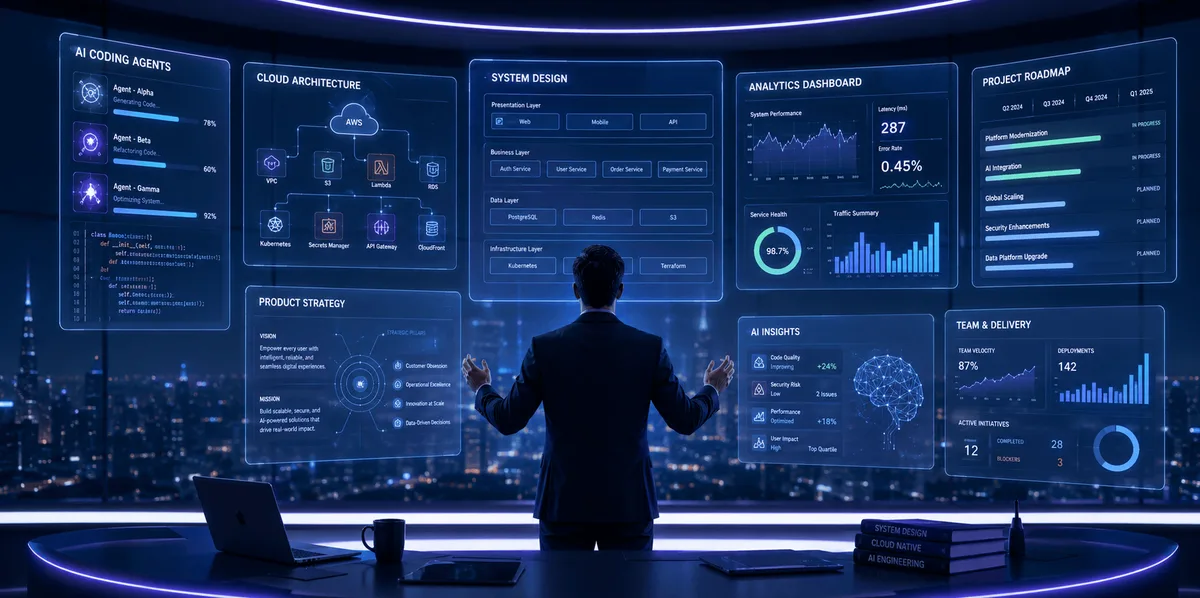
As AI becomes better at writing code, the most valuable engineers are no longer those who simply code faster. They are the ones who understand systems, architecture, business problems, and how technology creates value.
The era of the pure coder is fading!!
The Shift From Coding to Problem Solving
Twenty years ago, writing code was the bottleneck. Today, understanding the problem is often harder than implementing the solution.
AI can generate:
- REST APIs
- Database models
- Unit tests
- Frontend components
- Infrastructure templates
What AI cannot fully replace is:
- Understanding customer needs
- Making architectural trade-offs
- Designing scalable systems
- Balancing business priorities
- Leading teams through ambiguity
The engineer who understands the problem deeply will outperform the engineer who simply writes more code.
Real-World Example: Building a Travel Booking Platform
Consider a modern travel company like a large online travel agency. An AI coding agent can generate:
- Search APIs
- React components
- Database schemas
- Integration code
But who decides:
- Should the system be event-driven?
- Should services communicate synchronously or asynchronously?
- How do we handle airline failures?
- What should be cached?
- What impacts SEO?
- How do we scale during holiday peaks?
Those decisions require engineering judgment, not code generation. The value increasingly lies in system design rather than typing code.
Why Architecture Matters More Than Ever
As code generation becomes easier, architecture becomes the differentiator. Engineers who understand:
- Distributed systems
- Scalability
- Reliability
- Security
- Observability
- Cloud architecture
will become significantly more valuable. A poorly designed architecture can generate millions of lines of perfect code and still fail in production.
AI Is Creating a New Type of Engineer
The next generation of engineers will combine multiple disciplines.
Technical Skills
- System design
- Cloud architecture
- Security
- Data engineering
- AI integration
Business Skills
- Product thinking
- Customer empathy
- Cost optimization
- Prioritization
Leadership Skills
- Communication
- Stakeholder management
- Project execution
- Team collaboration
Future engineers will spend less time writing code and more time orchestrating solutions.
Real-World Example: Building an AI Agent
Imagine building an AI customer support agent. Writing the code is no longer the difficult part. The difficult questions are:
- What data should the agent access?
- Which tools should it call?
- What patterns do I follow for my tool design?
- How should permissions work?
- How do we prevent hallucinations?
- How do we measure success?
These are design and product decisions. The engineering challenge has moved up the stack.
The Rise of Systems Thinkers
The most successful engineers of the next decade will think in terms of systems.
Instead of asking:
“How do I write this code?”
they will ask:
“How should this entire system work?”
Systems thinkers understand:
- User journeys
- Business workflows
- Data movement
- Team interactions
- Platform capabilities
This broader perspective creates significantly more impact than coding alone.
What Engineers Should Focus On Today
To stay relevant in the AI era, invest in:
1. Learn System Design
Understand scalability, resiliency, and architectural patterns.
2. Develop Product Thinking
Learn why features exist, not just how they are implemented.
3. Improve Communication Skills
Great ideas create value only when they can be communicated effectively.
4. Learn AI-Native Development
Master tools like:
- Cursor
- GitHub Copilot
- Claude Code
- ChatGPT
- MCP Servers & MCP Tools
- AI Agents
5. Understand Business Outcomes
Connect engineering decisions to customer value and business metrics.
What I Have Observed as an Engineering Manager
In my own teams, I’ve noticed that AI dramatically reduces implementation time, but architectural decisions, system boundaries, and product trade-offs still require experienced engineers.
Will Coding Become Irrelevant?
No! Coding remains a fundamental skill. However, coding is rapidly becoming a commodity skill. Just as calculators did not eliminate mathematics, AI will not eliminate software engineering. Instead, AI raises the level at which engineers create value. The future belongs to engineers who can combine technical expertise with architecture, business understanding, leadership, and systems thinking.
The most valuable engineer in 2030 won’t be the one who writes the most code. It will be the one who understands how technology, people, systems, and business fit together.
AI Adoption in Software Engineering: What the Data Says
The shift toward AI-assisted software development is no longer a prediction, it’s already happening. Recent industry research shows that AI coding tools have become mainstream across engineering teams worldwide:
84% of Developers Are Using or Planning to Use AI
According to the 2025 Stack Overflow Developer Survey, 84% of developers are already using or planning to use AI tools in their development workflow, up from 76% the previous year. This indicates that AI is rapidly becoming a standard part of modern software development rather than an experimental technology.
Developers Complete Tasks Faster with AI Assistance
A GitHub-backed study [1] [2] found that developers using GitHub Copilot completed programming tasks 55% faster than developers working without AI assistance. The study suggests that AI is highly effective at reducing time spent on repetitive implementation work, allowing engineers to focus on higher-level problem-solving.
Productivity Gains Are Real, But Human Judgment Still Matters
Research from Microsoft and Accenture engineering teams found developers completed 7% to 22% more pull requests per week after adopting GitHub Copilot.
At the same time, studies show that AI is not a replacement for engineering expertise. Some research found experienced developers can become less productive when AI-generated suggestions require extensive review and correction.
Trust Remains a Challenge
While adoption continues to rise, developer trust has not kept pace.
The 2025 Stack Overflow survey [1] [2] found that only 29% of developers trust AI-generated outputs, down from 40% the previous year.
The same survey revealed that 46% of developers do not trust the accuracy of AI-generated output and continue to review AI-generated code carefully before shipping it to production.
Key Takeaway
This reinforces an important reality: AI can generate code, but engineers remain responsible for architecture, security, reliability, and business outcomes.
Conclusion
AI coding agents are changing software engineering faster than any technology shift in recent memory. The engineers who thrive will not necessarily be the ones who write the most code. They will be the ones who understand how systems connect, how businesses operate, how products create value, and how teams solve complex problems together. The future engineer is not simply a coder. They are an architect, strategist, problem solver, and technology leader.
Continue Reading
If you enjoyed this article, you may also like: