Leadership is often associated with making decisions, assigning work, and tracking progress. While those responsibilities are certainly part of the role, I’ve learned that great engineering leadership goes much deeper than delegation.
Over the years, one principle has consistently shaped my leadership style:
The best leaders don’t stand above their teams, they work alongside them.
Whether it’s discussing software architecture, reviewing technical designs, solving production challenges, or brainstorming ideas, I’ve always found that participating with the team creates stronger outcomes than simply directing from the sidelines.
This approach has helped build trust, encourage ownership, and create teams that continue to grow long after a project is complete.
What Collaborative Engineering Leadership Means
Collaborative leadership isn’t about writing every line of code or attending every meeting. It means being an active partner in your team’s success.
A collaborative engineering leader:
- Participates in technical discussions when needed.
- Guides architecture and design decisions.
- Helps remove blockers.
- Coaches engineers instead of simply giving instructions.
- Creates an environment where everyone feels comfortable sharing ideas.
The goal isn’t to control every decision. It’s to enable the team to make better decisions together.
Leadership Is More Than Delegation
Many new engineering managers believe leadership begins once they stop being hands-on. In reality, stepping away completely can create distance between leaders and their teams.
Delegation is important, but leadership also requires:
- Listening before deciding.
- Supporting engineers through technical challenges.
- Providing context instead of just tasks.
- Helping the team navigate uncertainty.
- Creating clarity when priorities change.
People don’t just need someone assigning work, they need someone who understands the challenges they’re facing.
Why Engineers Follow Leaders Who Stay Engaged
Software engineering is built on problem-solving, collaboration, and continuous learning. When leaders stay connected to the work, not to micromanage, but to understand, they gain credibility with their teams.
Being engaged allows leaders to:
- Understand technical trade-offs.
- Make better strategic decisions.
- Remove obstacles more effectively.
- Bridge communication between engineering and business.
- Earn trust through action rather than authority.
Engineers naturally respect leaders who understand the realities of building software.
The PARTNER Framework for Collaborative Leadership
Understanding collaborative leadership is one thing. Practicing it consistently is another. Over the years, I’ve found that collaborative leadership isn’t a single skill, it’s a collection of habits. Here’s a practical framework that I use and I believe it might be beneficial for you as well. I call it the PARTNER Framework.
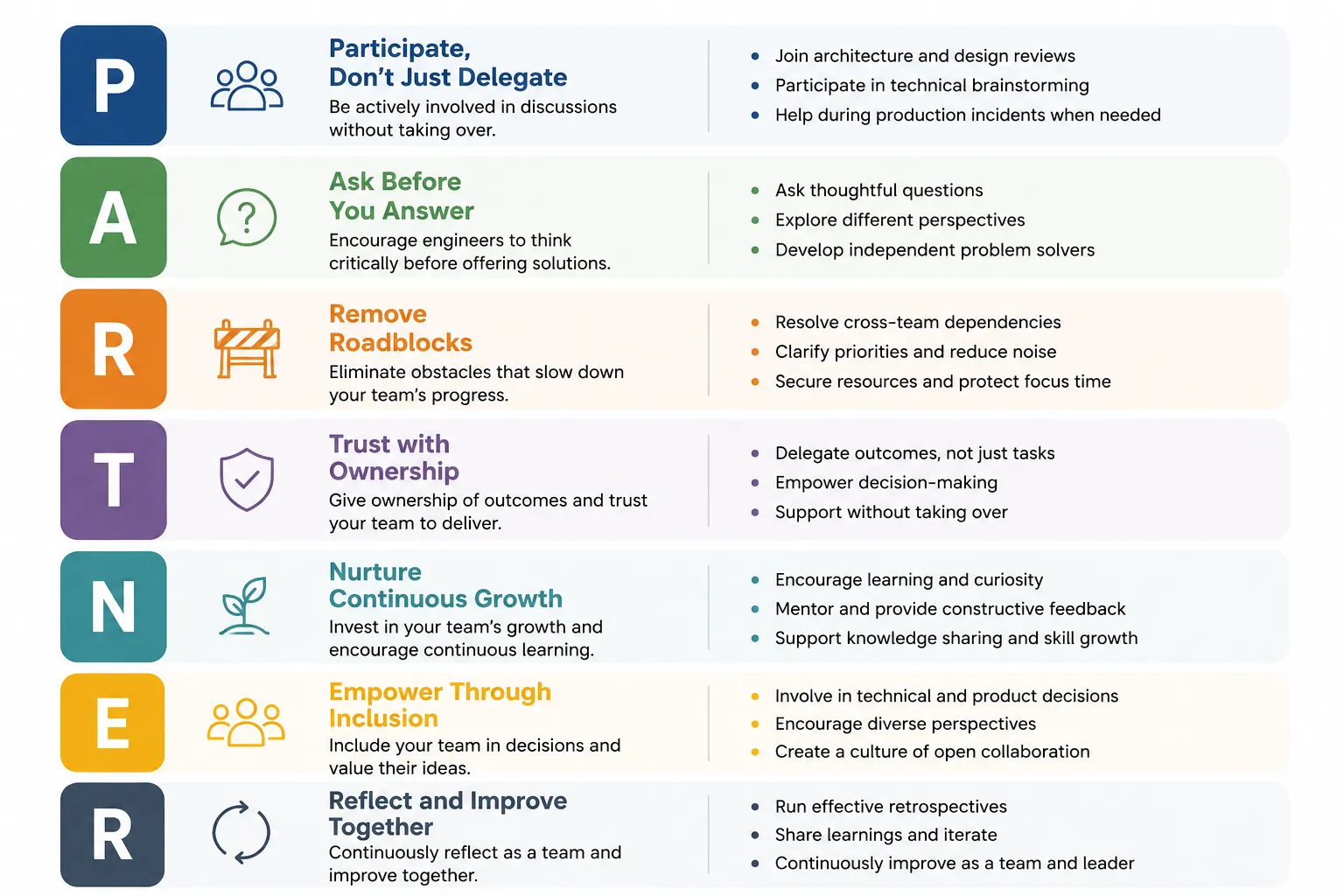
Here, each letter represents a leadership principle that helps create stronger engineering teams and future leaders.
P - Participate, Don’t Just Delegate
Be actively involved in discussions without taking over. Participation builds credibility and trust.
Examples:
- Join architecture and design reviews.
- Participate in technical brainstorming.
- Help during production incidents when needed.
A - Ask Before You Answer
Instead of immediately providing solutions, encourage engineers to think critically. Great leaders develop independent thinkers, not dependent followers.
Ask questions like:
- “What options have you considered?”
- “What trade-offs do you see?”
- “What would you do if I wasn’t here?”
R - Remove Roadblocks
One of a leader’s biggest responsibilities is enabling the team to succeed.
This includes:
- Resolving cross-team dependencies.
- Clarifying priorities.
- Eliminating unnecessary meetings.
Your job is to make it easier for the team to do great work.
T - Trust with Ownership
Ownership grows when trust is given before it’s earned perfectly. Allow engineers to make decisions while providing guidance and support when needed.
People grow when they’re trusted.
N - Nurture Continuous Growth
Every interaction is an opportunity to coach.
Encourage:
- Learning new technologies.
- Sharing knowledge.
- Mentoring peers.
- Leading small initiatives.
- Presenting technical proposals.
Great teams are built by growing great people.
E - Empower Through Inclusion
The best ideas rarely come from one person.
Include your team in:
- Technical decisions.
- Sprint planning.
- Architecture discussions.
- Retrospectives.
- Product conversations.
When people contribute to decisions, they naturally take ownership of the outcomes.
R - Reflect and Improve Together
Collaborative leadership is an ongoing practice.
Regularly ask:
- What worked well?
- What can we improve?
- What did we learn?
Continuous reflection strengthens both the team and the leader.
Let me summarize this into a tabular format so that you can take a shorter version with you
| Letter | Principle | Summary |
|---|---|---|
| P | Participate | Work with your team |
| A | Ask | Coach through questions |
| R | Remove Roadblocks | Enable success |
| T | Trust | Give ownership |
| N | Nurture | Develop people |
| E | Empower | Include everyone |
| R | Reflect | Continuously improve |
Note: The PARTNER Framework isn’t an industry-standard model. It’s a practical framework I’ve developed from my own experience leading distributed engineering teams. It captures the habits that have consistently helped build trust, ownership, and high-performing teams.
Participation Doesn’t Mean Micromanagement
One of the biggest misconceptions about collaborative leadership is that it leads to micromanagement. It doesn’t. There’s an important difference between being involved and taking over. Good leaders ask questions instead of providing immediate answers. They guide discussions instead of dominating them. They help teams think through problems instead of solving every problem themselves. The objective isn’t to become the smartest person in every meeting. It’s to help everyone else become more confident in making decisions.
The Benefits I’ve Seen Firsthand
Throughout my experience leading engineering teams, this collaborative approach has consistently produced better outcomes. Some of the biggest benefits include:
- Stronger trust between leaders and engineers.
- Greater ownership across the team.
- Faster onboarding of new team members.
- Better knowledge sharing.
- More open technical discussions.
- Higher engagement during planning and execution.
- Engineers becoming confident enough to lead initiatives independently.
One of the most rewarding moments for any engineering leader is seeing team members grow into leaders themselves. That growth rarely happens through instructions alone. It happens through collaboration, mentorship, and shared experiences.
Practical Ways to Lead Alongside Your Team
Collaborative leadership doesn’t require dramatic changes. Small habits often make the biggest difference. Some practices that have worked well include:
- Join architecture discussions without controlling every decision.
- Review designs collaboratively rather than simply approving them.
- Encourage engineers to explain their reasoning before offering your own.
- Ask thoughtful questions instead of immediately providing solutions.
- Be available during critical production incidents without taking over.
- Celebrate team achievements more than individual accomplishments.
- Treat mistakes as learning opportunities rather than assigning blame.
These habits create a culture where people feel trusted, supported, and empowered.
Common Leadership Mistakes
Many engineering managers unintentionally create distance from their teams. Some common mistakes include:
- Delegating tasks without providing context.
- Becoming disconnected from technical discussions.
- Giving solutions before understanding the problem.
- Measuring activity instead of outcomes.
- Making every important decision themselves.
Leadership isn’t about having every answer. It’s about helping the team discover the best answers together.
Building Future Leaders
One of the greatest responsibilities of an engineering leader is developing other leaders. When engineers feel trusted, included, and supported, they begin taking ownership naturally.
Over time, they become more confident in making technical decisions, mentoring others, and driving initiatives independently. That’s when leadership begins to scale. Instead of building a team that depends on one manager, you build a team capable of leading itself.
Final Thoughts
Over time, I’ve come to believe that leadership isn’t defined by authority, it’s defined by participation. The strongest engineering teams aren’t built through hierarchy alone. They’re built through collaboration, trust, and shared ownership. As leaders, our role isn’t simply to delegate work or oversee progress.
It’s to create an environment where people can do their best work, grow with confidence, and eventually become leaders themselves.
At the end of the day, leadership isn’t about standing above your team.
It’s about standing beside them, guiding, supporting, and growing together.
Frequently Asked Questions
What is collaborative leadership in engineering?
Collaborative leadership is a leadership style where engineering managers actively work with their teams, encourage shared decision-making, and support engineers instead of simply directing tasks.
Can an engineering manager remain technical?
Yes. Many effective engineering managers stay technically engaged by participating in architecture reviews, design discussions, mentoring, and technical strategy without becoming a bottleneck.
What is the difference between leadership and management?
Management focuses on planning, coordination, and execution, while leadership emphasizes vision, coaching, trust, and empowering people to achieve shared goals.
Why is trust important in engineering leadership?
Trust encourages open communication, improves collaboration, increases ownership, and enables engineers to make decisions confidently, resulting in stronger and more resilient teams.
Continue Reading
If you’d like to explore engineering leadership in more depth, these resources are excellent starting points:
- Google Project Aristotle
- Accelerate
- Martin Fowler on Technical Leadership
- The Phoenix Project
If you enjoyed this article, you may also like my other articles:
- How to Build a Slack AI Assistant with Node.js - Step by Step (Part 1)
- The Era of the Pure Coder Is Fading
- MCP Tool Design Best Practices
- Client-Side AI in Browsers
** This article expands on a leadership reflection I originally shared on my LinkedIn. The positive conversations it sparked inspired me to explore the idea in greater depth and share the practical lessons I’ve learned from leading engineering teams.
Original LinkedIn post: https://www.linkedin.com/posts/jokhan_over-time-ive-come-to-understand-that-leadership-share-7380985710482227200-rRSV/